
Temporary Housing vs. Extended Stay Hotels: Key Differences
June 11, 2025 by Kyle Estocapio
Temporary Housing vs. Extended Stay Hotels: Key Differences
Looking for a place to stay for weeks or months? Your options boil down to temporary housing (like furnished apartments) or extended stay hotels. Here’s a quick breakdown to help you decide:
- Temporary Housing: Offers a home-like feel with more space (750+ sq ft), full kitchens, and residential settings. Ideal for relocations, families, or those seeking privacy.
- Extended Stay Hotels: Combine hotel amenities (housekeeping, breakfast, fitness centers) with compact living spaces (365 sq ft). Perfect for business travelers, interns, or short-term stays.
Quick Comparison
| Feature | Temporary Housing | Extended Stay Hotels |
|---|---|---|
| Space | 750+ sq ft | 365 sq ft |
| Kitchen | Full-size | Kitchenette |
| Location | Residential neighborhoods | Near business hubs/airports |
| Cost | Varies, utilities separate | $1,000–$4,000/month, all-inclusive |
| Users | Families, relocations | Business travelers, interns |
| Flexibility | Requires planning, longer stays | Easy booking, short-term stays |
Bottom Line: If you want more space and a residential feel, go for temporary housing. For shorter, flexible stays with hotel perks, extended stay hotels are the way to go.
Main Differences: Temporary Housing vs Extended Stay Hotels
Basic Features
Temporary housing and extended stay hotels serve different needs, and their features reflect that. Temporary housing provides a more residential feel, with spacious layouts, full kitchens, separate living areas, and in-unit laundry facilities. It’s designed to feel like a home away from home [1].
Extended stay hotels, on the other hand, blend hotel services with apartment-style living. They offer compact spaces equipped with basic kitchen appliances. Their standout feature is the convenience of hotel-like services. Here’s a quick comparison:
| Service Category | Extended Stay Hotels | Temporary Housing |
|---|---|---|
| Daily Services | Continental breakfast, housekeeping, front desk support | Self-managed (housekeeping available for an extra fee) |
| Facilities | Pool, fitness center, meeting rooms, laundry service | Varies by property, often residential amenities |
| Utilities | All included in rate | May require separate setup and payment |
| Maintenance | 24/7 on-site support | Coordination through a property manager |
Common Users and Purposes
The differences in features naturally attract different types of users. The choice largely depends on individual priorities and circumstances.
Extended stay hotels are ideal for:
- Business professionals like executives, sales reps, and corporate trainers who need flexible lodging [3].
- Healthcare workers on temporary assignments [3].
- Entertainers, such as musicians and actors, traveling between cities [3].
- Transportation professionals, including pilots, flight attendants, and truck drivers, who require dependable accommodations [3].
Temporary housing is better suited for:
- Families or individuals in transition between permanent homes [4].
- People relocating to a new city [4].
- Those seeking more space and privacy during a long-term stay [7].
"If this is a possibility – or if you just want more flexibility – go with the extended stay hotel…you’ll have an easier time picking up and leaving." – Extra Space Storage [4]
Ultimately, the choice comes down to what matters most: convenience and flexibility or a more home-like, stable environment. Each option caters to specific needs, making both valuable depending on the situation.
What Makes Extended Stay Hotels Stand Out from the Market?
Cost Analysis
Getting a clear picture of cost differences is essential when deciding between extended stay hotels and temporary housing. Each option comes with its own pricing structure and additional expenses, which can significantly impact your budget.
Price Structures
Extended stay hotels and temporary housing rely on different pricing models. Extended stay hotels typically offer all-inclusive rates, often with discounts for longer stays. On average, a 30-day stay at an extended stay hotel costs about 20% more than a corporate apartment with a month-to-month lease [8].
Here’s how the base rates compare:
| Cost Component | Extended Stay Hotels | Temporary Housing |
|---|---|---|
| Daily Rate | $90–$250 per night | Varies by location |
| Utilities | Included | Separate |
| Housekeeping | Daily service included | Weekly/bi-weekly (extra fee) |
| Internet/Wi-Fi | Included | May require setup |
| Breakfast | Included | Not included |
Location plays a huge role in pricing. For example, a one-bedroom unit downtown could cost over $189 per night, while choosing a property further from the city center might save you nearly 40% [9].
Additional Expenses
Beyond the base rates, there are other costs to consider. These can vary significantly between extended stay hotels and temporary housing:
| Expense Category | Extended Stay Hotels | Temporary Housing |
|---|---|---|
| Utilities | Included | Separate utility bills |
| Maintenance | Included | Additional fees may apply |
| Security Deposit | Rarely required | Usually required |
"If you need a place to stay for less than a month, extended stay hotels may be your only option. If you need lodging for more than a month, corporate housing lacks some useful services (e.g., a daily breakfast buffet), but will usually provide a more comfortable and homelike atmosphere." – Biz-stay.com [8]
Extended stay hotels, especially limited-service properties, also have lower utility costs, averaging about 4.0% of their revenue [11]. However, utility costs have been on the rise, with a 3.5% average increase in 2023 and 2024. Annual per-room utility expenses now hover around $2,478 [10]. For those looking to manage their monthly expenses predictably, the all-inclusive nature of extended stay hotels can be a compelling choice.
Booking and Stay Terms
Contracts and Cancellations
When it comes to booking and cancellation policies, extended stay hotels and temporary housing options operate differently. Extended stay hotels typically follow standardized procedures, while temporary housing policies often vary depending on the agreement.
| Aspect | Extended Stay Hotels | Temporary Housing |
|---|---|---|
| Reservation Guarantee | Held until 6 PM on the arrival date | Depends on the agreement |
| Advance Purchase | Non-cancellable after 24 hours | Based on contract specifics |
| Initial Deposit | Usually one night’s stay | Varies by property |
| Cancellation Notice | 24–48 hours notice for standard rates | Defined by the agreement |
For extended stay hotels, there are additional fees to keep in mind:
- Early check-in fees: Full previous-day rate for arrivals before 7:00 AM, or $10 per hour for check-ins between 7:00 AM and noon [12].
- Pet fees: Up to $25 per day for the first 6 nights, then $15 per day thereafter.
- Smoking violation fees: Up to $250 per incident.
- Late check-out fees: $10 per hour after 11:00 AM.
The booking terms for these accommodations set the tone for a move-in process that can vary significantly between extended stay hotels and temporary housing.
Move-in Process
The documentation and procedures for moving in differ depending on the type of accommodation. Extended stay hotels typically have a straightforward check-in process, requiring:
- A government-issued photo ID
- A payment method (with a possible deposit)
- Vehicle registration details (if applicable)
- Photo IDs for all adult guests
- Third-party credit card authorization forms, if applicable [18]
Some properties have additional requirements. For example, Westgate Resorts asks guests to complete an "Extended Stay Discount Rental Rate Reservation Request Form", provide a 7-night deposit at booking, and pay a refundable $250 damage deposit upon check-in [13].
For temporary housing, short-term rental agreements usually include:
"If this is a possibility – or if you just want more flexibility – go with the extended stay hotel…you’ll have an easier time picking up and leaving." – Extra Space Storage [4]
Many travel experts suggest starting with a short-term hotel stay when relocating for work. This approach offers the flexibility to assess your job situation and explore housing options before committing to a longer lease [14].
sbb-itb-9679f3e
Living Space and Features
Room Layout and Space
When it comes to space, temporary housing offers more than double the size of extended-stay hotels – 750+ square feet versus just 365 square feet. This difference can drastically improve comfort and functionality, especially for longer stays [5].
| Feature | Extended-Stay Hotels | Temporary Housing |
|---|---|---|
| Average Space | 365 sq ft | 750+ sq ft |
| Layout Style | Studio or open concept | Separate rooms |
| Kitchen Type | Kitchenette | Full-size kitchen |
| Private Outdoor Space | Limited | Common |
| Workspace | Limited | Dedicated areas |
Extended-stay hotels typically feature open-concept layouts, where living and sleeping areas blend into one . On the other hand, temporary housing provides separate rooms, giving you distinct spaces for sleeping, living, and working [5].
Available Services
The services offered also highlight the contrast between these two options. Extended-stay hotels focus on convenience, offering built-in amenities, while temporary housing leans toward a more residential and independent experience.
Common amenities in extended-stay hotels include:
- Free high-speed WiFi
- On-site laundry facilities
- Daily or weekly housekeeping
- Continental breakfast
- Fitness center access
- Front desk assistance
Interestingly, over 50% of travelers staying for more than a week prioritize practical, home-like amenities over luxury offerings [20].
| Service Category | Extended-Stay Hotels | Temporary Housing |
|---|---|---|
| Kitchen Setup | Basic appliances | Full kitchen equipment |
| Shared Areas | Hotel-style amenities | Residential facilities |
| Maintenance | 24/7 hotel staff | Property management |
| Laundry | Shared facilities | Usually in-unit |
Extended-stay hotels aim to provide a "home-away-from-home" feel with easy access to conveniences [2]. Meanwhile, temporary housing delivers a more authentic residential vibe, allowing for greater independence and a sense of living in a real home .
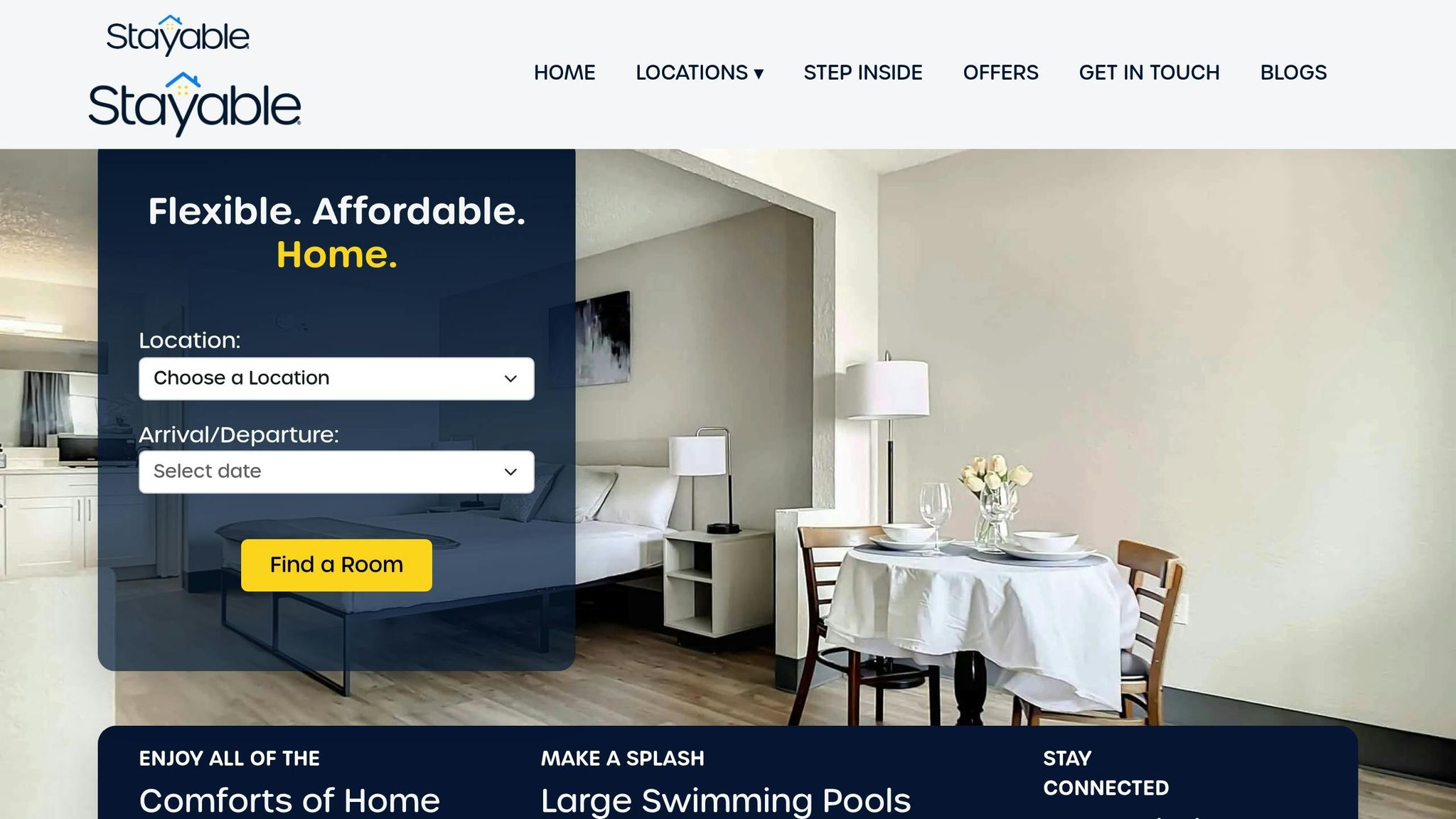
Extended Stay Hotels at Stayable
Lease Options
Stayable provides booking options tailored for weekly, monthly, or longer stays. Unlike many traditional extended-stay hotels that often lock guests into rigid agreements, Stayable focuses on simplicity and flexibility with easy-to-understand leasing terms [22].
Here’s how their payment structure works:
| Stay Duration | Payment Terms | Benefits |
|---|---|---|
| Weekly | Paid in advance | Perfect for short-term projects |
| Monthly | Paid in advance | Discounts available |
| Extended | Flexible terms | No binding long-term contracts |
Additionally, Stayable’s no-credit-check policy makes it a practical choice for individuals with less-than-perfect credit scores, streamlining the booking process [23]. These leasing options are paired with thoughtful suite amenities, designed to make every stay comfortable and convenient.
Room Features
Stayable’s suites are crafted to blend the comforts of home with the perks of a hotel. Every location offers functional, well-equipped rooms that cater to both short visits and extended stays [17].
Here’s what you can expect in their suites:
| Category | Included Amenities | Optional Services |
|---|---|---|
| Kitchen | Full-sized refrigerator, Microwave | – |
| Technology | Free Wi-Fi, Expanded cable TV | – |
| Workspace | Dedicated work station | – |
| Comfort | King or double/queen beds | Housekeeping services |
| Additional | Flat-screen TV | Linen exchange |
Some properties also feature unique amenities tailored to their location. For example, Stayable Kissimmee West, located just 10 miles from Walt Disney World and Universal Studios, offers family-friendly extras like a hot tub, kids’ pool, and playground [21]. The St. Augustine property includes a fitness center, while Kissimmee East provides 1,500 square feet of meeting space, perfect for business travelers [17].
"Clean, spacious suites. Affordable prices. Flexible options. The reasons to stay are endless." – Stayable [17]
Every Stayable property is strategically placed near key attractions and destinations. For instance, the Jacksonville West location offers quick access to downtown and the Prime F. Osborn III convention center, while the Lakeland property, conveniently located off I-4, provides easy routes to both Tampa and Orlando [17].
Making Your Choice
When deciding between temporary housing and extended stay hotels, several important factors can help steer your decision. One major difference lies in the living space available, which can greatly influence your comfort during an extended stay.
Here’s a quick comparison to help weigh your options:
| Factor | Extended Stay Hotels | Temporary Housing |
|---|---|---|
| Best Duration | Several months to under a year | A few months to over a year |
| Monthly Cost Range | $1,000-$4,000 | Varies by season and location |
| Move-in Process | Quick and simple | Requires more advanced planning |
| Location Options | Limited to hotel properties | More residential choices |
With this comparison in mind, think about what aligns best with your lifestyle and priorities. Extended stay hotels are ideal if you need flexibility and predictable monthly costs. They’re a solid choice if your plans might shift unexpectedly and you want a hassle-free arrangement.
On the other hand, temporary housing is better suited for those who want a more residential feel. As Kimberly Smith, an industry expert, explains:
"Relocating either for work or personal reasons shouldn’t mean giving up your accustomed way of living. If anything, relocating should be a smooth lifestyle transition complete with day-to-day conveniences and a few added bonuses" [5].
Here are some key factors to consider:
- Duration flexibility: Extended stay hotels are easier to book and cancel, while temporary housing offers better value for longer stays [4].
- Community feel: Temporary housing places you in residential neighborhoods, offering opportunities to connect with local communities.
- Amenities and support: Compare hotel-style conveniences with the broader support systems often found in temporary housing.
Ultimately, consider your personal circumstances and preferences to make the right choice. If your stay is short-term, extended stay hotels often provide more affordable rates. For longer stays, temporary housing can become a more cost-effective and comfortable solution . Don’t forget to account for all costs, including utilities, amenities, and any hidden fees, when making your decision.
FAQs
What should I consider when deciding between temporary housing and an extended stay hotel for a long-term stay?
When choosing between temporary housing and an extended stay hotel for a long-term stay, it’s important to weigh a few key factors:
-
Cost: Extended stay hotels often come with higher nightly rates, which can add up quickly over time. On the other hand, temporary housing typically offers more stable monthly pricing, making it a more budget-conscious choice for longer stays.
-
Flexibility: If your plans are uncertain, extended stay hotels might be the better option. They usually allow for easy extensions or early check-outs without the hassle of lease agreements. Temporary housing, however, often requires a longer commitment, which might not work if your schedule is unpredictable.
-
Amenities: Think about what will make your stay comfortable. Extended stay hotels often provide conveniences like kitchenettes, free Wi-Fi, and housekeeping services. Temporary housing, however, tends to offer more space and a homier feel, which can be a better fit for extended stays.
Taking these factors into account will help you decide which option aligns best with your needs and lifestyle.
What are the cost differences for utilities and services between temporary housing and extended-stay hotels?
In extended-stay hotels, utilities such as water, electricity, and trash services are usually part of the rental price, making them a budget-friendly alternative to temporary housing, where these costs are often charged separately. This all-in-one pricing model helps simplify your budget and keeps monthly expenses more predictable.
On top of that, extended-stay hotels often provide perks like free Wi-Fi and optional housekeeping services, which might carry extra charges in other types of temporary housing. These features add convenience and make extended-stay hotels an appealing option for those looking for flexibility and manageable costs.
What are the advantages of choosing temporary housing instead of an extended-stay hotel when relocating to a new city?
Temporary housing brings a range of perks for individuals or families making a move to a new city. For starters, it offers a cozy, home-like atmosphere that can ease the stress of transitioning. Being able to personalize the space and create a sense of normalcy is especially helpful for families looking for stability during this period of change.
Another advantage is the flexibility it provides. Many temporary housing options come with adjustable lease terms, so you can tailor your stay to your needs. Plus, most are fully furnished and include utilities, saving you the trouble of hauling furniture or setting up services. This combination of convenience and adaptability makes temporary housing an excellent choice for relocations.
Written by
